Lily Pad Workshop
A formation studio
We make tools that form the people who use them.

Step inside.
A formation studio
We make tools that form the people who use them.
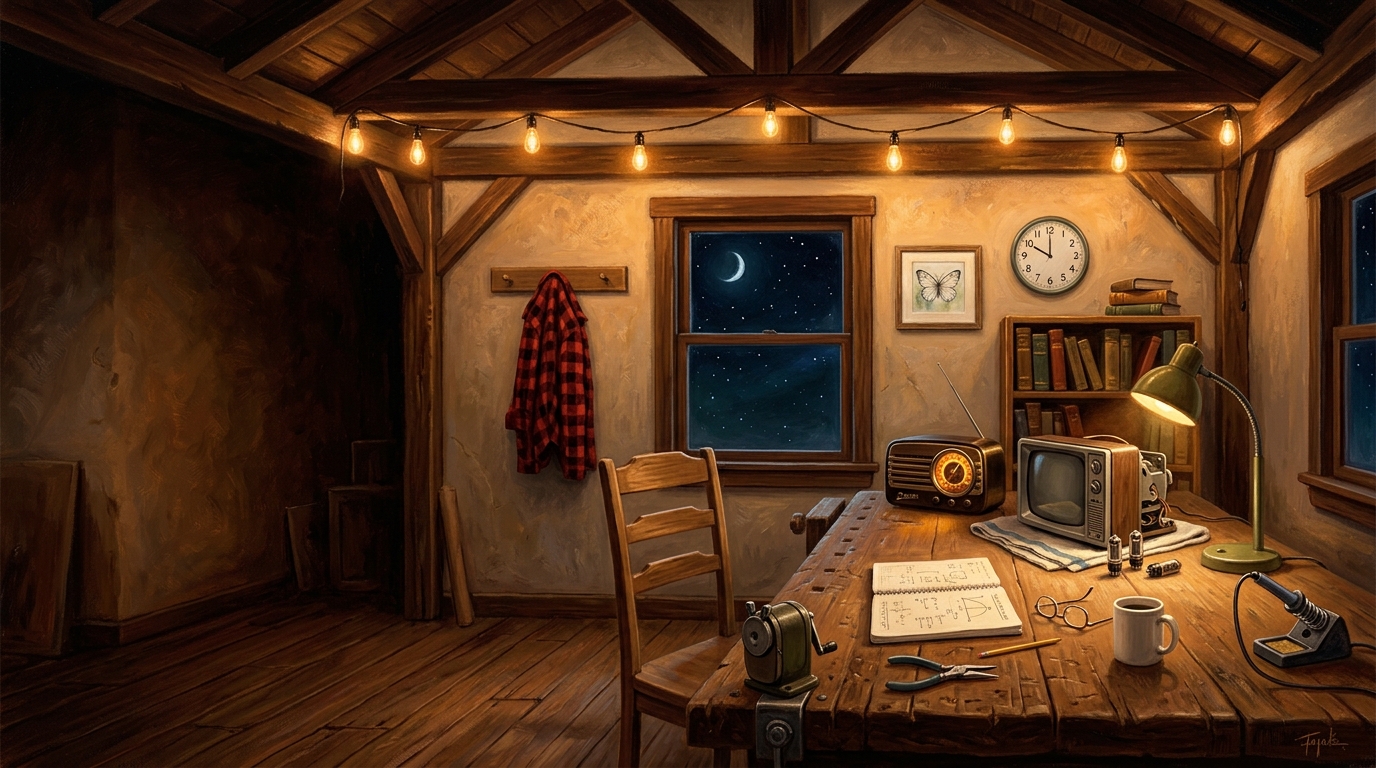
AM radio waves are long — hundreds of meters from crest to crest. Because they are long, they do something short waves cannot: they bend. They wrap around hills, diffract past buildings, follow the curvature of the earth itself. They are not precise. They are not high fidelity. But they travel.
FM waves are the opposite — short, tight, accurate. They carry more information, reproduce music with clarity, and travel in straight lines that stop at the horizon. FM is information. AM is presence.
At night, something remarkable happens. The ionosphere — a layer of atmosphere charged by the sun — cools after dark and descends. It becomes a mirror for long waves. AM signals that travel fifty miles by day bounce between the earth and the sky after sunset, skipping across a thousand miles or more. A voice from Chicago reaches a workshop in Florida. Not perfectly. Through static, through crackle, through the noise of a signal that has been reflected off the edge of space. But it arrives. The voice is real. The connection is real.
What AM radio lacks in fidelity, it gains in reach and in voice. You hear the grain of the recording, the hiss of the carrier wave, the warmth of a transmission that has been shaped by its journey. A thousand miles of atmosphere are in that sound. The signal carries not just information but the distance it has traveled — and that distance is part of the meaning.
On Christmas Eve, 1906, Reginald Fessenden made the first AM broadcast — a violin playing "O Holy Night" transmitted to ships at sea. Sailors heard music coming from their wireless sets and did not understand what was happening. A voice, a melody, harnessed onto photons and carried across the water. That is what this radio does. It catches what someone, somewhere, thought was worth sending into the dark.
The pattern is called buffalo check — large blocks of red and black, woven so that the warp and weft alternate colors at regular intervals. Where it came from depends on who you ask, and no one is entirely certain.
One story begins in Scotland with the Clan MacGregor and their tartan — the red and black pattern known as the Rob Roy. A descendant named Jock McCluskey carried it to the American frontier, where he traded heavy tartan blankets with Indigenous peoples for pelts and goods. They loved the warmth and the bold pattern, and the fabric moved along trade routes from Montana to the outposts and forts. The name "plaid" itself comes from the Gaelic word for blanket — plaide.
Another story places the origin at Woolrich Woolen Mills in central Pennsylvania, 1850. A designer who owned a herd of buffalo created the pattern to distinguish Woolrich in a crowded flannel market. The shirts were sold from a mule cart to the wives of lumberjacks, and the red and black check became the uniform of men who worked outdoors in the cold.
A third thread: a MacGregor Scotsman named John McGregor wore his clan's tartan and played his bagpipe at the Alamo during the final battle. It was the last music Davy Crockett and his men would ever hear.
Flannel itself is older than all of these stories — a Welsh word, gwlanen, for a cloth made from carded wool that is not pressed smooth. The fibers are left slightly raised, trapping air, holding warmth. It does not look refined. It looks like what it is: a fabric made to keep a working person warm in a cold place. It asks nothing of the wearer except that they have work to do.
The man who hung this shirt on this peg wore it because it was warm and because it was his. It fit the shape of his shoulders from years of wearing. He did not choose it. It chose him, the way all honest tools eventually do.
Sometimes there are no clear answers on the journey toward the truth. Sometimes the search itself is the formation.
The mechanical clock was invented in medieval monasteries. Monks needed to know when to pray — the Liturgy of the Hours divided the day into eight offices, from Matins before dawn to Compline at nightfall. Each had to be observed at the correct time. So they built machines to divide the day into equal parts and ring a bell when each part ended.
This changed everything. Before the clock, time was organic — an hour was longer in summer than in winter because it was measured by sunlight. After the clock, time became mechanical, uniform, abstract. Every hour was the same length regardless of the season. The monks gave the world standardized time as a byproduct of trying to pray on schedule.
In 1922, in Paris, Henri Bergson and Albert Einstein debated what time actually is. Einstein said time is what clocks measure — nothing more. Bergson said clocks do not read themselves. Time is something experienced by a conscious being — it is lived, felt, inhabited. He called this durée: duration. A minute of grief and a minute of joy are not the same minute, regardless of what the clock says.
Einstein won the argument. Physics claimed time. Philosophy lost it. But the question Bergson asked has never been answered: what is it like to be a being who experiences time passing? The clock on the wall measures one kind of time. The person sitting at the workbench lives in another. Formation happens in Bergson's time — in duration, in the slow accumulation of understanding. You cannot form a person at the speed of light.
In 1920, a fourteen-year-old boy named Philo Farnsworth was plowing a potato field in Rigby, Idaho. He looked at the rows behind him — parallel lines running to the horizon — and saw television. Not the word. The thing itself. He realized that an image could be captured and transmitted one line at a time, the way a field is plowed one row at a time. He sketched the idea for his high school chemistry teacher. He was twenty-one when he built the first working model. RCA spent millions trying to beat him. A farm boy from Idaho beat them all.
The cathode ray tube works by firing a beam of electrons at a phosphorescent screen. The beam sweeps across the screen in lines, top to bottom, sixty times per second. Each sweep paints one frame. The glow persists just long enough for your eye to see a continuous image. It is an illusion sustained by speed — by the fact that phosphor fades slowly and the eye forgives.
The vacuum tubes laid out on the cloth beside this set are the amplifiers. Each one is a glass envelope with a vacuum inside and metal elements that control the flow of electrons. When a tube fails, the screen goes dark or the sound dies. You open the back, find the bad tube — it looks the same as the others but it has lost its vacuum, or its filament has broken — and you replace it. The set plays again.
There was a time when sixty million people watched the same thing at the same moment on sets like this one. Ed Sullivan introducing Elvis. Walter Cronkite removing his glasses. Neil Armstrong's boot touching the dust. These were not programs. They were collective experiences, carried into every living room by cathode rays and vacuum tubes and the patience of men like Ted who kept the sets running.
Nobody fixes televisions anymore. When something breaks, you replace it. You do not open the back. You do not lay the parts out on a cloth. You do not learn what each piece does by the act of finding which one failed. Something is lost in that — not just a skill but a relationship. The relationship between a person and a machine that he understands well enough to heal.
A photon leaves the surface of the sun and reaches this desk lamp in eight minutes and twenty seconds, crossing ninety-three million miles of vacuum at 186,000 miles per second. But from the photon's own perspective, no time passes at all. At the speed of light, time stops. The Lorentz factor — the equation that Schwarzschild and Einstein used to describe the warping of spacetime — goes to infinity at c. The photon does not experience the journey. It is emitted and absorbed in the same instant. To the photon, there is no distance between the sun and this workbench. There is only the eternal present — a now that has no before and no after.
Newton was the first to split light open. He passed a beam of sunlight through a glass prism and discovered that white light is not white. It is every color at once — red, orange, yellow, green, blue, violet — each bending at a different angle because each has a different wavelength. The prism didn't add color. The color was already inside the light, waiting to be separated. Newton called it a spectrum.
A century later, Maxwell proved that light is an electromagnetic wave — the same phenomenon as the signal coming through Ted's radio, just vibrating at a different frequency. Radio waves are long and slow. Light waves are short and fast. But they are the same thing. The same equations describe both. The radio and the lamp are cousins — different expressions of the same underlying field.
Then Einstein showed that light is also a particle — a photon, a discrete packet of energy. Not a wave or a particle. Both. Neither. Something that behaves like a wave when you're not looking and like a particle when you are. The act of observing it changes what it is. This is not a metaphor. This is the physics.
Humans have been harnessing photons since we first controlled fire — a hundred thousand years of bending light to extend the day. Tallow candles. Whale oil lanterns. Gas lamps that lit the streets of London. And then Edison's filament — a thin wire inside a glass bulb, heated by electric current until it glows. The same principle as the sun: heat matter until it emits light. The filament bulbs strung on the rafters above this workbench are tiny suns, each one turning electricity into photons.
The desk lamp does something the string lights do not. It directs the light. The gooseneck arm, the metal shade, the cone of illumination falling on a specific area of the workbench — this is light in the service of attention. You point it where you need to see. Everything outside the cone falls into shadow. That is what attention does. That is what formation does. You direct your focus at one thing and stay with it until you can see it clearly.
Every object in this room is visible because photons are striking its surface and bouncing into your eyes. The red of the flannel, the amber of the radio dial, the cream of the notebook — these are not properties of the objects. They are properties of the light. The flannel absorbs every wavelength except red, and reflects red back to you. What you see is what the object gives back. Color is a conversation between light and matter, and your eye is listening.
All life on earth is built on this conversation. Plants capture photons from the sun and convert them into sugar and oxygen through photosynthesis. Every animal that eats a plant — and every animal that eats that animal — is running on captured sunlight. The energy in your muscles right now is solar energy, delayed. You are, in the most literal sense, powered by light.
Even at the bottom of the ocean, twenty thousand feet down, where no sunlight reaches, life still follows the photon. The hydrothermal vents that power deep-sea ecosystems are heated by radioactive decay in the earth's core — and those radioactive elements were forged in the hearts of massive stars and scattered by supernovae, which are themselves explosions of light. The heat at the bottom of the sea is starlight, delayed by billions of years. And in 2005, scientists discovered that some deep-sea bacteria near those vents harvest the faint infrared glow of the superheated water itself — photons, even there, even in the dark. Life learned to see by the earth's own dim fire.
The lamp on Ted's workbench is a small thing. A metal arm, a bulb, a cone of warm light falling on a pair of pliers and a notebook. But what it does — converting electricity into photons and directing them at work that matters — is what the sun does, what the stars do, what life itself has been doing since the first cell turned toward the light. The lamp is on. The work continues. The photons arrive, as they always have, without experiencing the journey.
Every wave in this room is a circle spinning. This circle. A point moves around it at a constant speed. At any moment, its height is the sine. Its horizontal distance from center is the cosine. Together they trace the coordinates of the point as it travels — (cos θ, sin θ) — and those two numbers describe every oscillation in the universe.
One full trip around the circle is 2π radians — roughly 6.28. At the top, sine is at its peak and cosine crosses zero. At the sides, cosine is at its extremes and sine crosses zero. They take turns. They are the same wave, shifted — cosine leads sine by a quarter turn. One is always where the other just was. This relationship — the phase between them — is the heartbeat of wave physics.
The radio on this workbench catches AM signals oscillating at about one million cycles per second. One million trips around this circle every second. The television receives signals at several hundred million cycles per second. The lamp emits light at five hundred trillion cycles per second. Same circle. Same sine. Same cosine. The only difference is the speed of the spin.
When you tune the radio dial, you are choosing a frequency — selecting which circle to listen to out of the millions spinning simultaneously in the air around you. Every station is a circle. Every color of light is a circle. Every note of music is a circle. The universe is filled with circles spinning at every conceivable speed, and what we call a wave is just the shadow of a circle projected onto a line.
A child who understands this diagram understands the foundation of everything electromagnetic in this workshop. The radio, the television, the lamp, the light through the window, the warmth on the workbench. All of it is circles. All of it is sine and cosine, taking turns, forever.
Before there were books, there were voices. Everything a people knew — their history, their laws, their understanding of the stars and the seasons — lived in the memory of a living person who spoke it aloud to the next person who would carry it. Homer did not write the Iliad. He sang it. And someone remembered it. And someone after them remembered it. For centuries, the chain held. When it broke, the knowledge was gone.
Then came the scribes. In the monasteries of Europe, in the scriptoria where the only light was candlelight and the only sound was the scratch of a quill on vellum, monks spent their lives copying texts by hand. A single book could take a year to produce. The pages were calfskin. The ink was iron gall and oak bark. Many of the scribes went blind from the work — years of close writing by dim firelight destroyed their vision, and they gave it willingly, because they believed the words were worth more than their sight.
Because of this labor, books were treasures. A monastery's library might hold a few hundred volumes, and those few hundred represented an almost unimaginable investment of human life. Books were chained to desks. They were locked in vaults. A peasant farmer could live an entire life and never hold one. Knowledge existed, but it was imprisoned by the cost of reproduction.
In 1440, in Mainz, Johannes Gutenberg solved the problem. Movable type — individual metal letters that could be arranged, inked, pressed onto paper, and rearranged to print the next page. A page that took a scribe a day could be printed in minutes. A book that cost a year's wages could cost a week's. Within fifty years, there were more books in Europe than had been produced in the previous thousand years combined.
Everything followed from this. Martin Luther's theses spread across Europe in weeks because of the press. The Scientific Revolution was conducted in printed journals that any literate person could read. The Enlightenment was a conversation held in books that were finally cheap enough for ordinary people to own. Democracy itself depends on the printing press — Jefferson's argument for public education assumed that the public could read, and reading assumed that books were available, and availability assumed Gutenberg.
The books on this shelf — Spinoza's Ethics, the works that Ted kept close — are here because of that chain. A voice in ancient Greece. A scribe in a candlelit monastery. A printer in Mainz. A bookshop in Ted's town. And now a shelf in a workshop, where a man who fixes radios reads philosophy after supper.
The story is not over. What the printing press did for information, something must now do for formation. Books democratized knowledge — anyone could read Aristotle. But reading Aristotle is not the same as sitting with a teacher who understands Aristotle and meets you where you are, who asks what you think and waits for your answer, who knows when to push and when to be silent. That kind of formation — Socratic, personal, patient — has always been locked behind the same economics that once locked away books. One teacher, one student, an enormous cost. Only institutions could afford it. Everyone else got lectures.
The next shelf is being built now.